
August is when the bill comes due
Most Ocean County lawns don't die in August. They die in June and July, and August is just when you finally notice.
That sounds like a technicality. It isn't — it's the whole reason the usual advice fails here. By the time the lawn is visibly brown, the roots are already gone, and no amount of watering brings back a root system that shrank two months ago. The lawns that sail through a Shore August are the ones that were set up in spring.
Here are the five things that actually kill grass between Toms River and Long Beach Island, in the order they do the damage.
Note: this is about established lawns. If you just had sod installed and it's browning, that's a different problem with a different fix — see Why Is My New Sod Turning Brown?
Cause #1: Your soil is sand, and sand doesn't hold water
What it looks like: The lawn is fine two days after rain and crispy on day three. Brown starts at the high points and along the driveway and sidewalk, then spreads inward.
Why it happens: This is the one that makes the Shore different from the rest of New Jersey. A loam soil in Morris County holds roughly two inches of plant-available water in the top foot. Coastal sand holds well under half that. Same rainfall, same heat — the sandy lawn runs out first, and it runs out fast.
So the honest answer to "how often should I water?" is different here. Advice written for Ohio or even North Jersey will underwater a Shore lawn.
How to fix it:
- Water deeply and less often — about an inch to an inch and a half per week, in two or three soakings, not a daily sprinkle
- Put a tuna can on the lawn while the sprinklers run; when it's full, you've delivered about an inch
- Water between 4 and 9 AM. Midday loses a large share to evaporation; evening leaves blades wet overnight and invites fungus
- Fix the soil, not just the watering — compost worked into sand is what raises its water-holding capacity in the first place
Cause #2: You're irrigating by hand, or not at all
What it looks like: The lawn is green in a rough arc around wherever the hose reaches and brown everywhere else. Or it's uniformly stressed because nobody watered while you were away for a week.
Why it happens: A cool-season lawn in sandy coastal soil needs water on a schedule the weather sets, not one your calendar sets. Nobody hand-waters correctly for eight straight weeks in July heat. It isn't a discipline problem — it's that hitting an inch of even coverage with a hose and an oscillating sprinkler is genuinely hard.
This is why we tell homeowners that any lawn over roughly 1,500 square feet needs in-ground irrigation to survive a Shore summer. Below that, a diligent person with a hose can manage. Above it, the odds turn against you.
How to fix it:
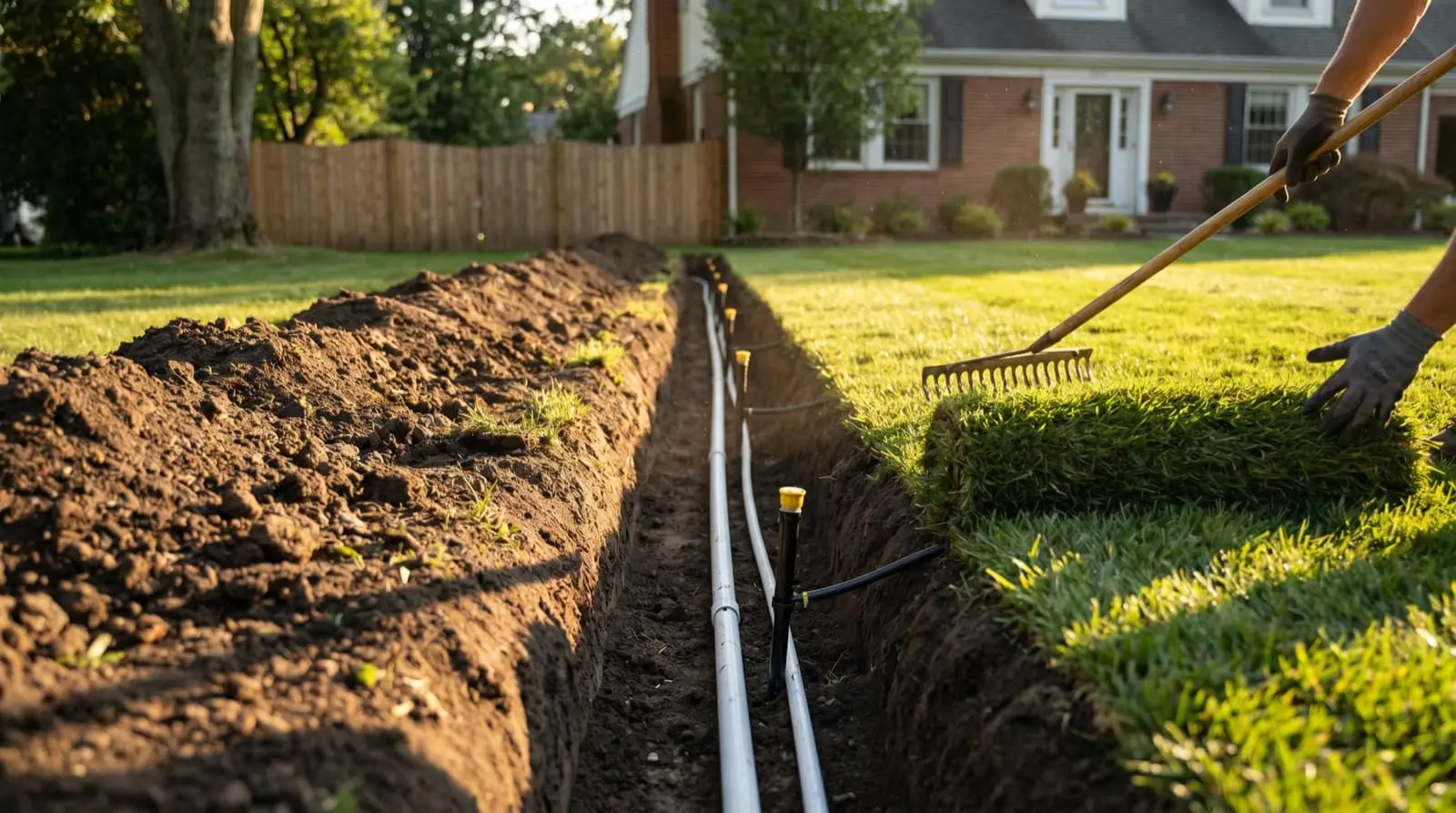
- A zoned in-ground system for a typical residential lawn runs $2,850 to $3,950 installed, designed around your yard's sun exposure and soil
- Zones matter more than head count. A shaded side yard and a south-facing front lawn want completely different run times, and one zone can't do both
- A smart controller pulls local weather and skips cycles after rain, which matters in a place that gets coastal storms
- Already have a system? A $150 turn-on and evaluation will find the heads that have drifted, sunk, or been clipped by a mower — that's usually where the brown stripes come from
See what irrigation actually costs →
Cause #3: Mowing too short in the heat
What it looks like: The lawn browns within a few days of a mow, and the brown is uniform rather than patchy. Weeds show up in the thin spots a few weeks later.
Why it happens: Grass blade length and root depth track each other. Scalp the top and you shorten the roots, right when the plant needs every inch of root it has to reach moisture that's already draining past it.
Short grass also exposes soil to direct sun, which raises soil temperature and dries it faster. In sand, that compounds quickly.
How to fix it:
- Raise the deck to 3.5 to 4 inches from June through September. This is the single cheapest thing on this list and it works
- Never take more than a third of the blade in one pass
- Keep the blade sharp. A dull blade tears the tip, and torn tips brown and lose water faster than cut ones
- Leave the clippings. They return moisture and nitrogen instead of hauling both away
Cause #4: Fertilizing at the wrong time
What it looks like: The lawn greens up for about ten days after a summer feeding and then browns worse than before.
Why it happens: Nitrogen tells cool-season grass to push new top growth. In 90-degree heat, with sandy soil that's already short on water, you've just asked a plant under stress to spend energy it doesn't have. And nitrogen moves through sand fast — much of what you apply in July is past the root zone before the grass uses it.
How to fix it:
- Do the heavy feeding in fall. September and October are when cool-season grass actually builds roots at the Shore, and it's the highest-return application of the year
- If you feed in summer at all, go light and slow-release
- Get a soil test before guessing. Sandy Shore soil often runs acidic, and if the pH is off, the fertilizer can't be taken up no matter how much you apply
Cause #5: The lawn is the wrong grass, or it's simply finished
What it looks like: You do everything above and it still thins out every summer. Or it comes back patchier each year, with more crabgrass filling the gaps.
Why it happens: Two separate things get confused here.
The first is dormancy, which is normal. Cool-season grass idles in extreme heat, goes tan, and greens back up when temperatures drop. Tug a handful — if the crown at the base is still firm and pale rather than brown and crumbly, it's dormant, not dead, and it will return.
The second is a lawn that's genuinely done. Most Shore lawns that fail every single summer are a thin builder-grade seed mix sitting on compacted sand with no organic matter under it. No watering schedule fixes that, because the problem is below the grass.
How to fix it:
- Grass type matters. We install a tall fescue blend grown nine months on a New Jersey farm — deep-rooted, which is exactly what sand rewards
- If it's the soil, it has to be rebuilt, not topped up. That means tear-out, composted topsoil, lime, and starter fertilizer before anything green goes down. Installed sod runs $2.50 to $4.00 per square foot in Ocean County, about $2.85 on a typical job
- Don't reseed into sand in July. Seeding in summer heat at the Shore fails more often than it works — wait for fall, or sod it
How much does sod installation cost? →
The realistic order to fix things
If you're standing in a brown lawn in August, do them in this order:
- Raise the mower. Free, immediate, and it helps this week
- Water deeply in the early morning, an inch to an inch and a half per week across two or three soakings
- Check your coverage before assuming the grass is dead — a sunken or blocked head explains a surprising share of brown patches
- Wait on fertilizer until September
- Then decide in fall whether it's a maintenance problem or a soil problem
That last step is the honest one. If the lawn has browned out every August for three years running, the watering isn't the issue — the ground underneath is. Fall is the right time to rebuild it, and it's also the least expensive time of year to do it.
A word on timing
Fall is the best window for both sod and irrigation at the Shore. Soil is still warm enough to root, air is cool enough not to cook new grass, and the lawn gets all of autumn and spring to establish before it ever faces another August.
That's not a sales line — it's why we book more work in September and October than any other month.
Serving Ocean County
We install sod and in-ground irrigation across Ocean County, including Toms River, Brick, Point Pleasant, Lakewood, Jackson, Barnegat, Manahawkin, and Long Beach Island. We also deliver farm-direct sod by the pallet if you're doing the work yourself — about $550 per pallet, covering roughly 500 square feet.
Want a real number for your yard? Get a free quote or call 848-301-1569.